Animals in Irish are ainmhithe (one animal is an ainmhí). Dog is madra (MOD-ruh), cat is cat (KOT), horse is capall (KOP-ul), cow is bó (BOE) and sheep is caora (KAY-ruh).
Caora! That's me. Bulut the sheep, at your service. You'll find me on this list, next to my cousin the uan (lamb).
Below: the full list of Irish animal words, from the farmyard to the hedgerow, the grammar that makes bó turn into an bhó, regional words for "dog", and the animals that turn up on old Irish coins and in Irish legends.
Irish animal words
Farm animals, pets, wild Irish animals, birds and fish, all in one table. Notes show plurals and "the" forms where they change.
Farm animals in Irish
Ireland is a farming country, and the farm words are some of the oldest in the language. A feirm (FER-im) has:
- bó, cow, with the irregular plural ba (BAH); tarbh, bull; lao, calf
- caora, sheep, plural caoirigh (KEE-rih); uan, lamb; reithe, ram
- capall, horse; asal, donkey; muc, pig; gabhar, goat
- cearc, hen; coileach, rooster; lacha, duck; gé, goose
A neat memory hook links the farm to the kitchen. Many meat words are simply the animal plus feoil (meat): muiceoil is pork (pig-meat), caoireoil is mutton (sheep-meat) and uaineoil is lamb (lamb-meat). Beef is mairteoil, from mart, an old word for a beef animal. More kitchen words are on our food and drink in Irish page.
Pets in Irish
A pet is a peata (PAT-uh). To say you have one, Irish uses "there is … at me":
- Tá madra agam. taw MOD-ruh AG-um
- Tá dhá chat agam. taw GHAW KHOT AG-um
- An bhfuil peata agat? un will PAT-uh AG-ut
Two things to notice in Tá dhá chat agam. After dhá (two), the noun stays singular, so "two cat", not "two cats". And dhá softens it: cat becomes chat. The numbers page explains how this works from one to ten: see numbers in Irish.
Young animals have their own words: coileán (puppy), piscín (kitten), uan (lamb), lao (calf).
Wild Irish animals
These are the animals you might actually meet on an Irish walk, plus a few from the sea and sky.
| Irish | English | Good to know |
|---|---|---|
| sionnach / madra rua | fox | Madra rua is literally "red dog". |
| giorria | hare | Not the same as coinín, rabbit. |
| broc | badger | One short syllable: BRUK. |
| gráinneog | hedgehog | Feminine: an ghráinneog. |
| iora rua | red squirrel | Rua is the red of red hair and foxes. |
| madra uisce / dobharchú | otter | "Water dog" and "water hound". Both names are in use. |
| rón | seal | Seals turn up in many coastal legends. |
| spideog | robin | The garden favorite. |
| bradán | salmon | The Salmon of Knowledge, an Bradán Feasa. |
Notice how often madra (dog) and rua (red) build new animals. Irish likes to describe: a fox is a red dog, an otter is a water dog, a whale is a míol mór, a "big creature".
The cow, the sheep: how "the" changes animal words
Every Irish noun is masculine or feminine, and you can hear it as soon as you add an (the). This is the grammar point that makes animal words a great place to start.
| Type of noun | What an does | Examples |
|---|---|---|
| Masculine, starts with a consonant | nothing | an madra, an cat, an capall |
| Feminine, starts with a consonant | adds h (softens) | an bhó (un VOE), an chaora (un KHAY-ruh), an mhuc (un WUK), an chearc |
| Masculine, starts with a vowel | adds t- | an t-uan (un TOO-un), an t-éan, an t-asal, an t-iasc |
| Feminine, starts with a vowel | nothing | an ialtóg (the bat) |
In the plural the article is na, which adds an h before a vowel: na madraí (the dogs), na ba (the cows), na caoirigh (the sheep), but na héin (the birds). Want the full picture of these sound changes? Read séimhiú and urú explained.
Possessives work the same way as with family words. One learner might call Bulut mo chaora (muh KHAY-ruh, my sheep); to the whole Craic team, Bulut is ár gcaora (ar GAY-ruh, our sheep). The gc is eclipsis: the g takes over and the c goes silent.
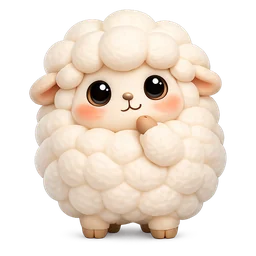
Ewe heard right: one caora, two caoirigh. Like English "sheep", it's the plural that's strange, just strange in a different way.
Dialect notes
Stress also moves in Munster when the second syllable has a long vowel: coinín is kun-EEN there, and coileán kil-AWN. Elsewhere the first syllable takes the stress.
Common mistakes
- "an bó" instead of an bhó. Bó is feminine, so the article softens it.
- "an uan" instead of an t-uan. Masculine nouns starting with a vowel get t-.
- "dhá cait" instead of dhá chat. After dhá: singular noun, softened.
- "bós" or "bóanna" for cows. The plural is the short, irregular ba.
- Reading cat as "cat". The Irish word sounds like KOT, with an open "o".
Animals in Irish culture
Coins. When the Irish Free State issued its first coins in 1928, it put animals on them instead of rulers: a horse, a salmon, a bull, a wolfhound, a hare, a hen with chicks, a sow with piglets and a woodcock. The Central Bank of Ireland tells the story; collectors still call the set the "barnyard" coins.
Legends. The great epic Táin Bó Cuailnge, the Cattle Raid of Cooley, is a war over a prize bull. In the Fionn mac Cumhaill stories, young Fionn gains all the world's wisdom by burning his thumb on an Bradán Feasa, the Salmon of Knowledge.
Proverbs. Two animal sayings every learner meets: Bíonn adharca fada ar na ba thar lear, "cows overseas have long horns" (the grass is always greener), and Briseann an dúchas trí shúile an chait, "nature breaks out through the eyes of the cat". There are more in our Irish proverbs collection.
No snakes. Ireland has no native snakes, and legend gives Saint Patrick the credit. The Irish word is still worth knowing: nathair, which also turns up in the phrase nathair nimhe, a venomous snake.
Questions people ask
What is dog in Irish?
Madra (MOD-ruh). Plural: madraí. Munster also uses gadhar.
What is the Irish word for sheep?
Caora (KAY-ruh, or KEE-ruh in Connacht and Ulster). Plural: caoirigh. A lamb is an uan.
What is fox in Irish?
Sionnach (SHUN-ukh), or madra rua, "red dog".
Is "cat" really the same in Irish?
Same spelling, different sound: KOT. The plural is cait (KOTCH).
Craic takes words like madra, cat and caora into real sentences you build step by step, with Bulut cheering you on and a native-like voice for every word.
Get Craic for iPhoneKeep going

Food and drink in Irish
Cupán tae, pionta, arán agus im, and how to order politely.
Read
Family in Irish
Máthair, athair, deartháir, deirfiúr and how mo changes them.
Read
Numbers in Irish
1–1,000, counting things, counting people and the mutations.
Read
Irish proverbs
38 real seanfhocail with pronunciation and true meanings.
Read